


Pipe Stress Analysis according to ASME B31.3 and EN 13480
-
 21hr
-
 594 enrollments
-
Rated 4.9 / 5.0
-
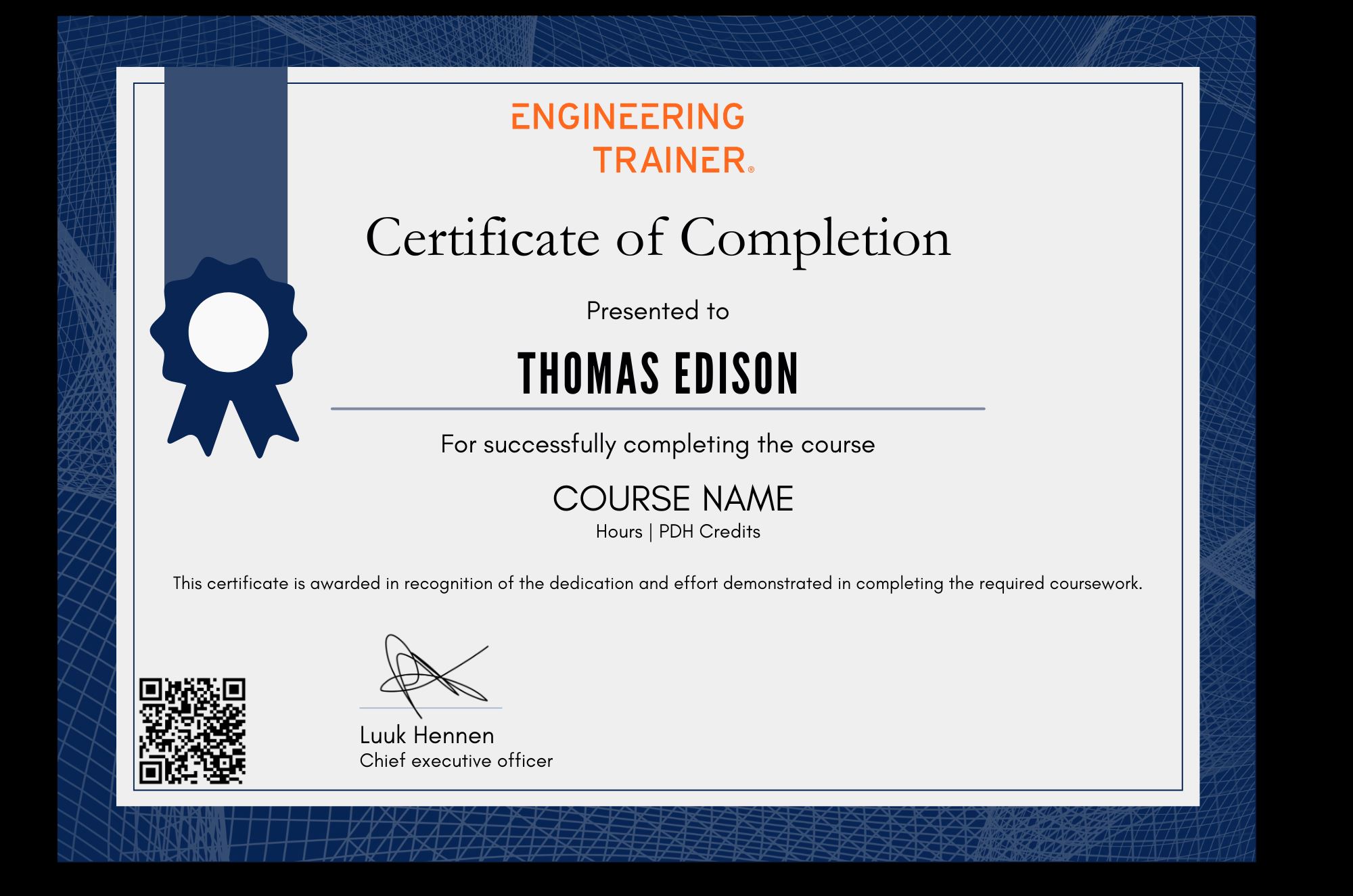
Certificate included
-
Self-paced
-
ASME B31.3
-
EN 13480
Why take this course?
This pipe-stress analysis course explains the physics, load cases, allowable values and failure mechanisms behind ASME B31.3 and EN 13480 calculations. It helps engineers perform basic hand checks, interpret software output and assess practical responses to excessive stresses, loads or displacements. This self-paced online course includes video lectures, knowledge-check quizzes and a completion certificate with PDH credits.

What you'll learn
After this course, you will be able to:
• understand the physics and equations behind pipe stress analysis
• determine material allowable values according to relevant design codes
• identify relevant load cases and failure mechanisms
• understand how components, supports and load conditions influence the analysis
• perform a basic pipe stress analysis by hand using ASME B31.3 and EN 13480 principles
• review pipe stress software output with stronger engineering judgment
• identify practical responses to excessive pipe stresses, nozzle loads, support loads and displacements
-
 1-year access
-
 By Industry Experts
-
 100% Online Course
About the course
Pipe stress analysis is not only a software task. Engineers need to understand the assumptions, load cases, allowable values, and failure mechanisms behind the results.
This course gives you a structured foundation in pipe stress analysis according to ASME B31.3 and EN 13480. It explains the basic physics and code logic behind pipe stress checks, then connects these principles to supports, load conditions, overstressed locations, nozzle loads, support loads, and displacements.
This is not a CAESAR II or pipe stress software tutorial. The focus is on understanding what the software is calculating, why certain checks are required, and how to judge whether the results make sense.
-
Self-Paced Course

-
21hr
-
21 PDH Credit

-
English

-
SPC114

Meet your instructor
Dynaflow Research Group
Dynaflow Research Group is an engineering consultancy working across piping design and analysis, flow dynamics, vibration, FRP piping, pressure equipment and specialist engineering software. Its experience includes EN and ASME design rules for piping and pressure vessels, buried piping, water hammer, pulsation, dynamic stress assessment, vibration measurement, FEA tools, BOSfluids, BOSpulse, PV Elite and NozzlePRO workflows.

Who should attend this course
• Junior pipe stress engineers building a structured foundation• Piping designers who need to understand stress-analysis decisions
• Pipe stress software users who need to understand the theory behind the output
• Pipe stress engineers applying ASME B31.3 or EN 13480
• Technical reviewers checking pipe stress analyses
• Experienced pipe stress engineers refreshing code and analysis fundamentals
Program & Details
-
Module 1 - Basics of Pipe Stress

Build the technical foundation required to understand pipe stress calculations.
- Pipe geometry and typical pipe properties
- Forces, moments, external forces, and bending moments
- Stress directions: hoop, axial, radial, and shear stress
- Stress-strain theory
- Piping codes, material codes, code stress, and allowable values -
Module 2 - Piping Components
Learn how common piping components affect pipe stress analysis.
- Straight pipe and wall thickness concepts
- Thin- and thick-walled pipe
- Bends, reducers, and tees
- Flanges, valves, and nozzles -
Module 3 - Supporting & Load Conditions
Understand how supports and load conditions influence piping system behaviour.
- Support types, stiffness, gaps, and friction
- Spring supports and steel structures
- Process conditions, imposed displacements, and occasional loads
- Supporting a simple piping system -
Module 4 - Failure Modes & Allowable Values
Learn how piping systems are assessed against load types and failure mechanisms.
- Load types and failure mechanisms
- Sustained, occasional, and operating loads
- Expansion and fatigue
- Load case construction -
Module 5 - Performing a Pipe Stress Analysis
Work through the main checks used in a pipe stress code conformance assessment.
- Flexibility analysis
- Stress Intensification Factors (SIFs)
- Code stress definitions and allowable values
- Nozzle, flange, support, and displacement checks
- Role of pipe stress software -
Module 6 - Solving Overstressed Locations
Learn how to identify overstressed locations and evaluate practical design solutions.
- Solution process for overstressed piping systems
- Identification of overstressed locations
- Model detail and resolution
- Design improvements
- Expansion loops and bellows -
Module 7 - Advanced Topics
Explore additional topics that often appear in pipe stress engineering work.
- Reporting a pipe stress analysis
- Fiberglass Reinforced Plastic (FRP) piping
- Buried piping systems
- Water hammer phenomena
Certification
Related courses


Why choose EngineeringTrainer
-
Unlimited Team-wide Access
-
Advance Technical Competences
-
Courses by Industry Authorities
The course was well-structured and informative, with clear explanations, helpful learning aids, and practical comparisons between codes that made the differences easier to understand.
Senior Piping Stress Engineer, VIRO
Request a Quote
Train Smarter. Grow Faster.
Build real-world skills that help you make better engineering decisions, reduce errors, and stand out in your field.