


(Workshop) LOF Calculations: Quantitative Assessment of FIV & AIV in Main Lines
-
 Wednesday 13 Jan 2027
(1-3pm CST / 8-10pm CET)
-
 2 Hour Session
-
Interactive Q&A
-
Trusted by professionals
-
Certification included
Why take this course?
Flow-Induced Vibration (FIV) and Acoustic-Induced Vibration (AIV) can lead to fatigue failures in process piping, yet the associated risks are not always apparent from conventional pipe stress assessments. In this 2-hour live workshop, pipework vibration specialist Neil Parkinson explains how to apply the Energy Institute Guidelines to calculate and interpret Likelihood of Failure (LOF) scores for main piping lines. Through practical calculation examples, participants will develop engineering judgement about which parameters matter most and how assessment results can guide engineering decisions.
What you'll learn
After this live workshop, you:
• understand the quantitative assessment methodology for main piping lines described in the Energy Institute Guidelines for the Avoidance of Vibration Induced Fatigue Failure in Process Pipework;
• understand the purpose and limitations of Likelihood of Failure (LOF) calculations as a screening method for vibration-induced fatigue;
• know which process conditions, piping characteristics and operating parameters are required to perform FIV and AIV assessments and how changes in these parameters can influence LOF scores;
• have worked through practical examples of LOF calculations, following the assessment methodology and relevant decision steps;
• are better equipped to interpret LOF results, identify potentially problematic piping systems and determine where further investigation or corrective action may be necessary.
-
 Wednesday 13 Jan 2027
(1-3pm CST / 8-10pm CET)
-
 Instructor-Led 2hr Duration
-
 Online Live Session
About the course
Vibration-induced fatigue is an important integrity concern in process piping systems. Even during normal operation, flow turbulence and high-frequency acoustic excitation can generate dynamic forces that may eventually lead to fatigue cracking, particularly at vulnerable piping connections and welded discontinuities.
Assessing these risks requires more than a conventional static pipe stress analysis. The Energy Institute's Guidelines for the Avoidance of Vibration Induced Fatigue Failure in Process Pipework provide established quantitative screening methods for assessing the Likelihood of Failure (LOF) associated with different vibration mechanisms.
During this 2-hour instructor-led workshop, Neil Parkinson focuses specifically on the quantitative assessment of main piping lines for two important vibration mechanisms: Flow-Induced Vibration (FIV), associated with turbulence generated by fluid flow, and Acoustic-Induced Vibration (AIV), associated with high-frequency acoustic energy, particularly in gas systems containing pressure-reducing devices. The emphasis is on main-line LOF calculations, rather than the separate assessment methodologies used for small-bore connections and other vibration-sensitive components.
The workshop explains the quantitative assessment methods described in the Energy Institute Guidelines, including the required input parameters, calculation steps and interpretation of the resulting LOF scores.
For FIV, attention is given to how fluid properties, flow velocity, piping configuration and support stiffness influence the calculated likelihood of failure. For AIV, the focus is on acoustic excitation generated by pressure reductions, the transmission of acoustic energy and the vulnerability of piping connections and welded discontinuities.
Using practical calculation examples, Neil will guide participants through the assessment process and highlight which parameters have the greatest influence on the results. The workshop also explains how to interpret LOF scores as screening indicators rather than absolute probabilities of failure, and how the findings can support decisions concerning further investigation, design modifications or vibration mitigation.
The objective is to help engineers better understand and apply these quantitative assessment methods when evaluating vibration-related fatigue risks in main piping lines.
-
Live Workshop

-
Wednesday 13 Jan 2027 (1-3pm CST / 8-10pm CET)
-
2 PDH Credits

-
English

-
MAS1601a

Meet your instructor
Neil Parkinson
Structural Integrity Monitoring and Pipework Vibrations


Who should attend this course
This workshop is particularly relevant to Pipe Stress Engineers, Piping Engineers and Mechanical Engineers involved in the design, analysis and assessment of process piping systems.It is also valuable for Asset Integrity, Reliability, Maintenance and Inspection Engineers responsible for assessing vibration-related fatigue risks in operating facilities, as well as Process Engineers involved in evaluating flow conditions and operating parameters that may contribute to piping vibration.
The workshop is intended for engineering professionals seeking a more detailed understanding of quantitative vibration assessment methods.
Prerequisites
Participants should have a working knowledge of industrial piping systems and basic engineering principles, including flow conditions, pressure, piping geometry and mechanical behaviour.Familiarity with the differences between Flow-Induced Vibration (FIV) and Acoustic-Induced Vibration (AIV), including their excitation mechanisms and potential consequences for piping integrity, is recommended. Previous experience performing Energy Institute LOF calculations is not required.
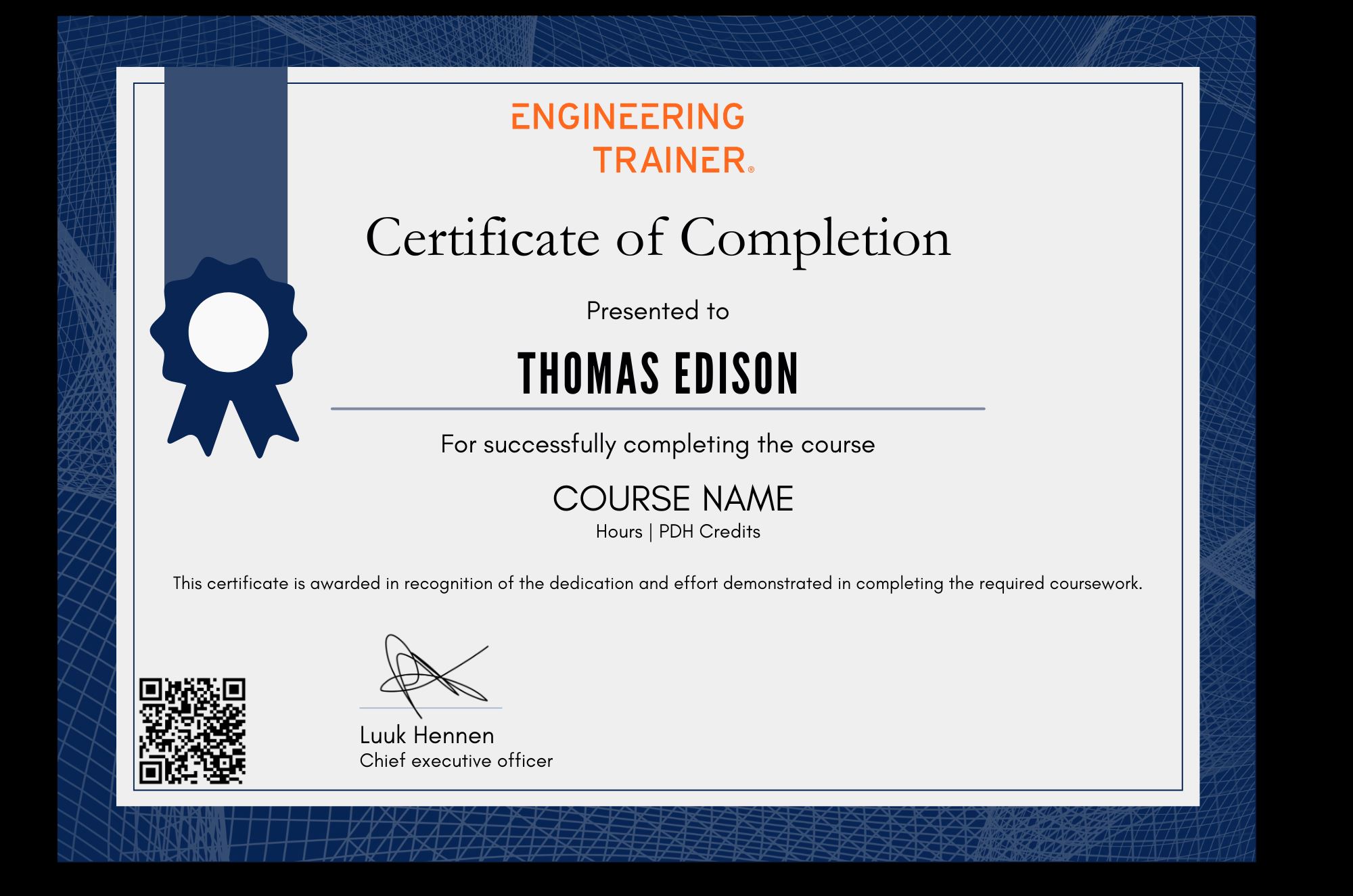
Certification
Related courses


Why choose EngineeringTrainer
-
Live Interaction with Experts
-
Advance Technical Competences
-
Courses by Industry Authorities
Since using EngineeringTrainer our internal mentorship has a much more matured character.
Logan Chapman - COO at Chapman Consulting Inc.
Request a Quote
Train Smarter. Grow Faster.
Build real-world skills that help you make better engineering decisions, reduce errors, and stand out in your field.