


Anti-Friction Bearing Fundamentals
-
 2hr
-
 Self paced
-
Trusted by professionals
-
Certification included
-
Industry standard content
Why take this course?
This anti-friction bearing course explains bearing functions, loads, friction, lubrication, components and terminology. It compares ball, cylindrical, tapered, spherical and needle-roller bearings so engineers can relate bearing design to an application. This self-paced online course includes video lectures and a completion certificate with PDH credits.

What you'll learn
After completing this course, you...
• Understand bearing theory (friction, loads etc.) and terminology.
• Know the different bearing types (thrust, angular, self-aligning etc.).
• Know their components,
• Know the basics of lubrication,
• Understand which bearing is suitable for which application and why.
-
 1-year access
-
 By Industry Experts
-
 100% Online Course
About the course
Learn about anti-friction bearing components, designs, and applications. Ideal for all engineering industries.
Humans have been using anti-friction bearings (rolling contact bearings) for thousands of years. But what are anti-friction bearings? Why are there so many different types? And why does every engineer need to know a little bit about them?
In this course, you will learn:
History of anti-friction bearings.
Bearing theory (friction, loads etc.).
Bearing functions.
Bearing lubrication.
Bearing components.
Bearing terminology.
Ball and roller bearings.
Bearing types (thrust, angular, self-aligning etc.).
Which bearing is suitable for which application.
And a lot more!
This course gives you all the fundamental understanding you need about the bearings and can also be used later as a refresher course. Whatever your level of understanding, or engineering background (mechanical engineering, HVAC, chemical engineering, oil & gas industry, power engineering, etc.), this course will provide you with a strong understanding of bearings and their details.
-
Self-Paced Course

-
2hr
-
2 PDH Credits

-
English

-
SPC707

Meet your instructor
saVRee
saVRee is an engineering-training company that uses interactive 3D models, video lessons and technical reference material to explain industrial equipment and processes. Since 2017, its material has covered valves, pumps, bearings, heat exchangers, boilers and power-generation machinery for technical learners and industrial teams.

Who should attend this course
• Rotating-equipment engineers responsible for anti-friction bearings• Mechanical engineers who specify or review bearing applications
• Reliability engineers investigating bearing performance or failure
• Maintenance engineers responsible for bearing inspection or replacement
• Maintenance technicians working with rotating or moving equipment
Program & Details
-
Introduction

1. Introduction
2. History -
Bearing Functions
1. Bearing Functions
2. Friction
3. Loads
4. Guide Parts -
Bearing Lubricants
1. Bearing Lubrication
2. Lubricant Types -
Components
1. Components
-
Terminology
1. Terminology
2. Alignment
3. Single and Double Row
4. Full Complement
5. Floating Bearings -
Anti-Friction Bearing Types
1. Anti-Friction Bearing Types
2. Movement Types
3. Point and Line Contact
4. Tapered and NonTapered
5. Shields and Seals
6. Shields
7. Seals
8. 3D Seals and Shields -
Ball Bearings
1. Ball Bearings
2. Single and Double Row
3. Shallow and Deep Groove
4. Thrust Ball Bearings
5. Angular Contact Ball Bearings
6. Conrad and Angular Contact Bearing Comparison
7. Contact Angle
8. 3D Ball Bearing Summary
9. 3D Thrust Ball Bearings -
Roller Bearings
1. Roller Bearings
2. Cylindrical Roller Bearings
3. 3D Cylindrical Roller Bearings
4. Tapered Roller Bearings
5. 3D Tapered Roller Bearings
6. Spherical Roller Bearings
7. 3D Spherical Roller Bearing
8. Needle Roller Bearings
9. 3D Needle Roller Bearing -
Bearing Comparison
1. Bearing Comparison
2. Bearing Chart -
Refresher Lesson
1. Anti-Friction Bearings Refresher Lesson
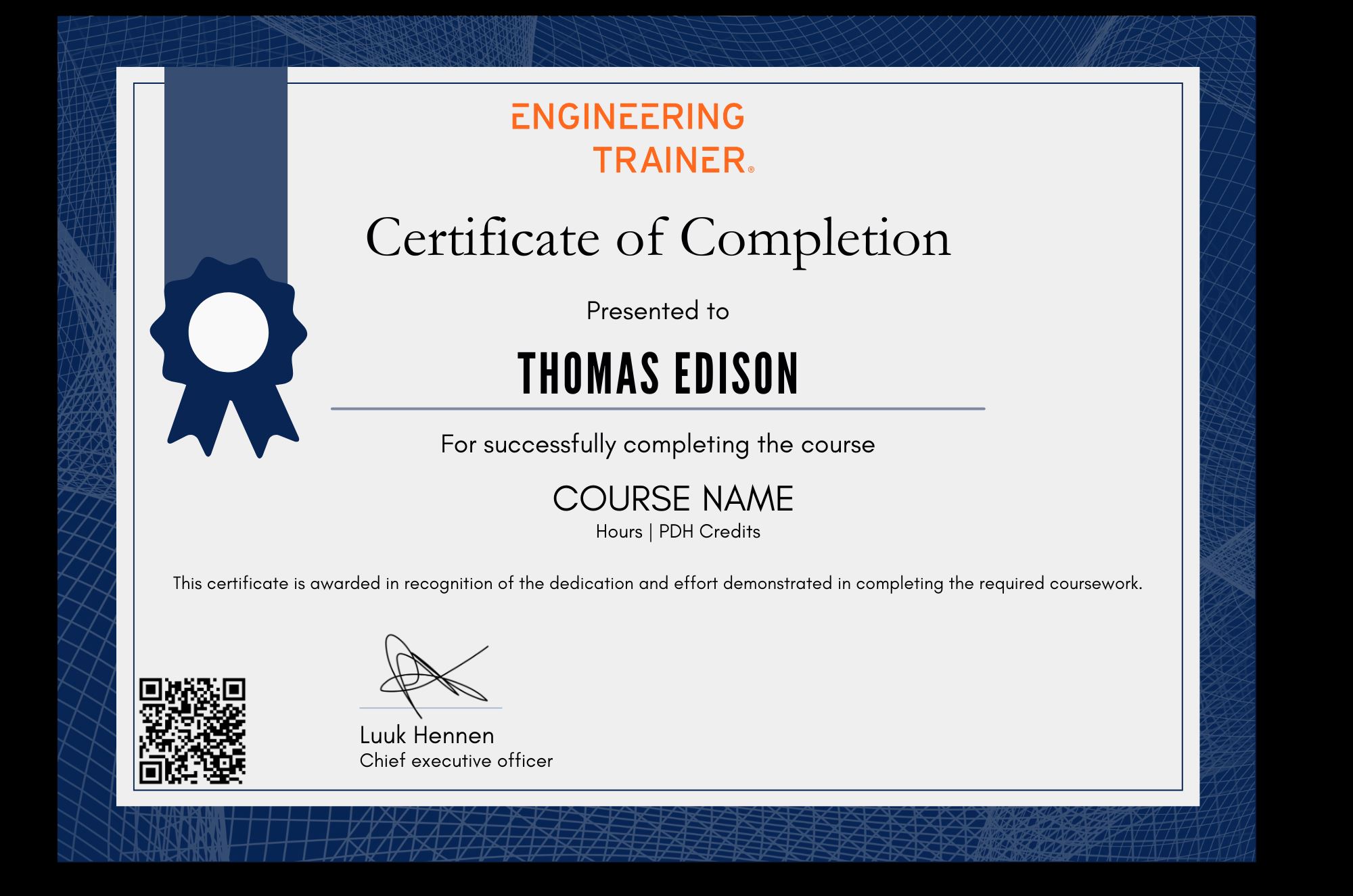
Certification
Related courses




Why choose EngineeringTrainer
-
Unlimited Team-wide Access
-
Advance Technical Competences
-
Courses by Industry Authorities
Since using EngineeringTrainer our internal mentorship has a much more matured character.
Logan Chapman - COO at Chapman Consulting Inc.
Request a Quote
Train Smarter. Grow Faster.
Build real-world skills that help you make better engineering decisions, reduce errors, and stand out in your field.