


Introduction to Centrifugal Pumps
-
 2hr 30min
-
 Self paced
-
Trusted by professionals
-
Certification included
-
Industry standard content
Why take this course?
This centrifugal-pump course explains pump construction, impeller and flow classifications, operating principles and characteristic curves. It also covers NPSH, cavitation, gas binding, priming and common protection decisions. This self-paced online course includes video lectures and a completion certificate with PDH credits.

What you'll learn
After completing this course, you...
• can identify the main components of a centrifugal pump and explain their purpose
• understand how a centrifugal pump converts rotational input into fluid flow and pressure
• can distinguish radial, axial, mixed-flow and multistage pump arrangements
• can read a basic centrifugal-pump characteristic curve
• can recognize cavitation, gas binding and loss-of-prime conditions
• understand the role of NPSH, priming and common protection methods
-
 1-year access
-
 By Industry Experts
-
 100% Online Course
About the course
The centrifugal pump is the most common and widely used pump today. Its simple construction, low maintenance, and low cost have made it an ideal pump for widespread commercial application.
In this course, you will learn:
How a centrifugal pump works.
All of the centrifugal pumps' main components.
Different impeller and centrifugal pump designs.
How to read a pump performance curve.
How to identify pump faults.
And a lot more!
The course is designed to take you from zero to hero concerning centrifugal pump knowledge. Even if you already have some background knowledge, this course will serve as an efficient refresher. Whatever your level of understanding, or engineering background (mechanical engineering, HVAC, chemical engineering, oil & gas industry, power engineering etc.), this course will provide you with a strong understanding of centrifugal pumps and their details.
-
Self-Paced Course

-
2hr 30min
-
2.5 PDH Credits

-
English

-
SPC703

Meet your instructor
saVRee
saVRee is an engineering-training company that uses interactive 3D models, video lessons and technical reference material to explain industrial equipment and processes. Since 2017, its material has covered valves, pumps, bearings, heat exchangers, boilers and power-generation machinery for technical learners and industrial teams.

Who should attend this course
• Mechanical engineers who need a foundation in centrifugal pumps• Rotating-equipment engineers starting work with centrifugal pumps
• Process engineers involved in pump selection or system operation
• Piping engineers who interface with centrifugal pumps
• Maintenance engineers responsible for pump condition or repair
• Operations personnel who operate pumped systems
Program & Details
-
Course Overview

1. Centrifugal Pumps Course Overview
2. Introduction to Pumps
3. Centrifugal Pump Components Explained
4. How Centrifugal Pumps Work
5. Centrifugal Pump Fundamentals
6. Introduction To Centrifugal Pumps -
Classification By Impeller Type
1. Impeller Classification
2. Axial and Radial Loads Explained
3. Centrifugal Pump Impellers Explained -
Pump Classifications
1. Centrifugal Pump Classification by Flow
2. Radial Flow Pumps
3. Axial Flow Pumps
4. Mixed Flow Pumps
5. Multi-Stage Centrifugal Pumps -
Centrifugal Pump Components
1. Centrifugal Pump Components
2. Diffuser
3. Wear Rings
4. Stuffing Box
5. Lantern Ring
6. Mechanical Seal
7. Centrifugal Pumps Summary -
Centrifugal Pump Operations
1. Centrifugal Pump Operation
2. Introduction to Centrifugal Pump Operation
3. Cavitation
4. Net Positive Suction Head
5. Centrifugal Pump Characteristic Curve
6. Centrifugal Pump Protection
7. Gas Binding
8. Priming Centrifugal Pumps
9. Centrifugal Pump Operation Summary
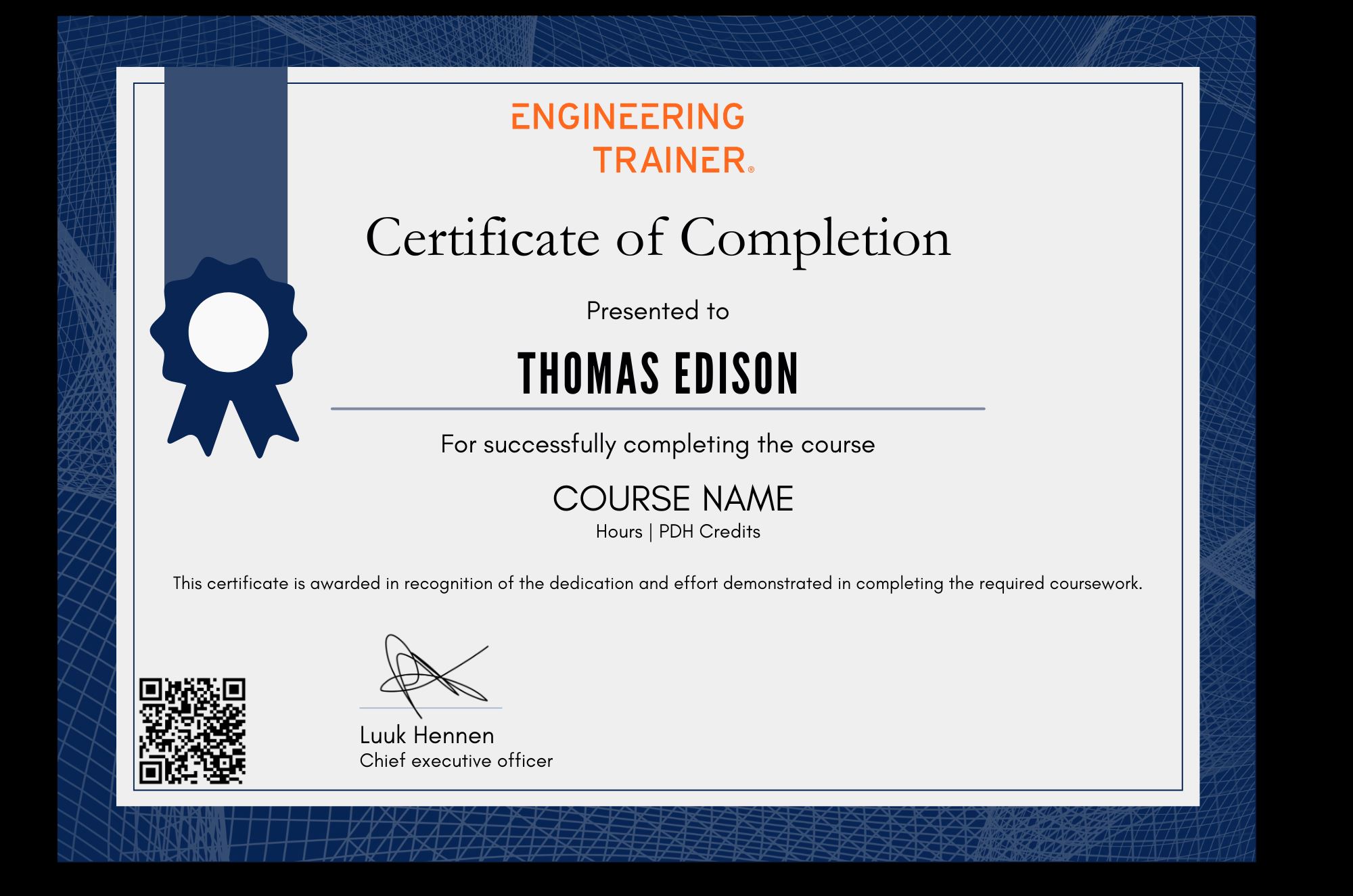
Certification
Related courses



Why choose EngineeringTrainer
-
Unlimited Team-wide Access
-
Advance Technical Competences
-
Courses by Industry Authorities
Since using EngineeringTrainer our internal mentorship has a much more matured character.
Logan Chapman - COO at Chapman Consulting Inc.
Request a Quote
Train Smarter. Grow Faster.
Build real-world skills that help you make better engineering decisions, reduce errors, and stand out in your field.