




Water Hammer Phenomena in Industrial Piping Systems
-
 5hr 30mins
-
 Self paced
-
Trusted by professionals
-
Certification included
-
Industry standard content
Why take this course?
This course develops essential engineering judgment on Water Hammer, focusing on real-life applications beyond theory. It explains how pressure transients develop in industrial piping systems and how valves, pumps, pipe properties, and system layout influence surge behaviour. You’ll learn to identify risk areas and assess practical mitigation measures for safer, more reliable systems.

What you'll learn
After completing this course, you will be able to:
• Explain the fundamental principles behind water hammer and pressure surge phenomena.
• Understand how pressure waves develop and travel through industrial piping systems.
• Apply the Joukowsky equation and understand its practical limitations.
• Calculate wavespeed and recognize the influence of pipe properties, fluid conditions, and system configuration.
• Evaluate the effect of valve closure, valve characteristics, pump trips, pump start-up, and pump switchover scenarios.
• Recognize cavitation risks and pressure collapse effects in transient events.
• Understand the role of pressure losses, boundary conditions, fluid temperature, buried piping, bends, tees, and branched systems.
• Identify critical surge-sensitive locations in piping systems, including process plants, jetty lines, deluge, firewater, and sprinkler systems.
• Assess mitigation measures and understand the trade-off between transient protection and steady-state system performance.
• Interpret practical water hammer case studies and use them to support better engineering decisions.
-
 1-year access
-
 By Industry Experts
-
 100% Online Course
About the course
This course provides a comprehensive understanding of water hammer phenomena in industrial piping systems. It combines the essential theory behind transient pressure events with practical examples from process plants, jetty lines, pump systems, firewater systems, deluge systems, sprinkler systems, and buried piping networks.
The course starts with the principles of water hammer, including pressure wave propagation, wavespeed, the Joukowsky equation, valve closure behaviour, frictional damping, unbalanced forces, and cavitation. It then moves into practical industrial cases, showing how pump trips, pump start-up, valve operation, orifice selection, pressure losses, temperature effects, and boundary conditions influence pressure surge behaviour.
Throughout the course, you will learn how to identify vulnerable parts of a piping system, evaluate surge-sensitive locations, and assess mitigation strategies. The emphasis is on developing sound engineering judgment: understanding not only what happens during a water hammer event, but also why it happens and how it can be managed in real systems.
-
Self-Paced Course

-
5hr 30mins
-
5.5 PDH Credits

-
English

-
SPC027

Meet your instructor
Dynaflow Research Group
Dynaflow Research Group is an advanced engineering consultancy specializing in complex piping, mechanical, structural, vibration, and dynamic analysis. Their work focuses on technically demanding industrial problems where calculation quality, code understanding, physical insight, and engineering judgement are critical. Their courses turn this specialist consulting experience into practical training, helping engineers understand the principles, assumptions, failure mechanisms, and design decisions behind real engineering systems.

Who should attend this course
This course is designed for engineers and technical professionals involved in industrial piping systems, pressure surge analysis, system evaluation, or transient flow behaviour.It is especially relevant for:
• Piping engineers, process engineers, mechanical engineers, and system design engineers.
• Engineers involved in pressure surge analysis, water hammer studies, or system integrity assessments.
• Engineers who need to evaluate or report pressure surge behaviour in their own piping systems.
• Professionals working with pumps, valves, deluge systems, firewater systems, sprinkler systems, jetty lines, buried piping, or process plant networks.
• Engineers who want to better understand practical mitigation options for water hammer and pressure surge events.
Program & Details
-
Module 1 - Water Hammer Physics

1. What is water hammer?
2. Friction: damping & line-packing
3. The Joukowsky equation
4. Unbalanced forces due to water hammer
5. Cavitation in piping
6. Cavitation in elevated piping sections
7. Calculating the wavespeed
8. Water hammer scenarios and risks -
Module 2 - Simple Valve Closure Downstream of a Tank
1. Principles of Water Hammer,
2. Example 1a: Instant Valve Closing
3. Unbalanced Loads in a closing valve scenario
4. Joukowsky Equation, a closer look
5. Example 1b: Joukowsky Equation -
Module 3 - Valve Closure in a Jetty Line
1. Module Overview
2. Wave Speed in Pipes
3. Valve Types and Closure Curves
4. Example 1: Valve Types
5. Cavitation, a closer look
6. Example 2: Cavitation
7. Example 3: Water Hammer in Jetty Line
8. Outro -
Module 4 - Pump Trips and Switchover in a Process Plant
1. The pump trip scenario
2. Results upstream and downstream of the pump (amongst others: pressure fluctuations, flow, unbalanced loads)
3. The influence of pump moment of inertia and initial steady state flow
4. Pump curves
5. Cavitation downstream of the pump
6. System (pump) start-up scenarios
7. Good practices & pump properties -
Module 5 - Orifice Selection in Deluge Systems
1. Introduction
2. Theory - Orifices
3. Example A: Orifice in a Gas System
4. Example B: Orifice in a Firewater System -
Module 6 - Pressure Loss and Buried Systems
1. Introduction
2. Pressure Loss in a Straight Pipe
3. Pressure Loss in Bends & Tees
4. Boundary Conditions
5. Impact of Wave Speed on Buried Systems
6. Impact of Fluid Temperature
7. Example: Water Hammer in a Buried Firewater System
8. Summary -
Module 7 - Mitigation Measures in Industrial Piping Systems
1. Course Introduction
2. Mitigation Measures
3. Example: Pipeline Mitigation
4. Example: Emergency Shutdown
5. Summary
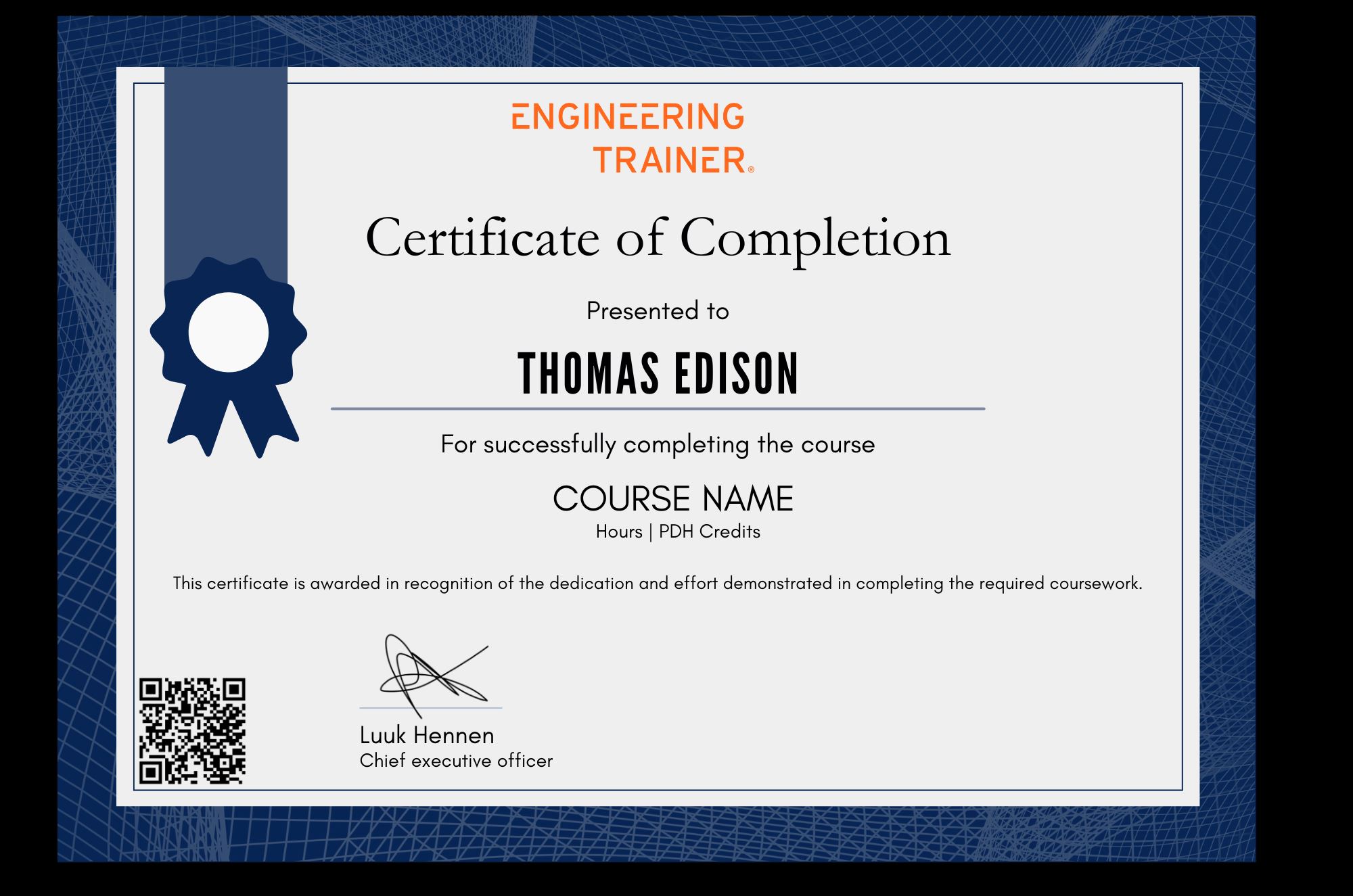
Certification
Related courses



Why choose EngineeringTrainer
-
Unlimited Team-wide Access
-
Advance Technical Competences
-
Courses by Industry Authorities
The examples using the software showcase exactly what is needed. The combination with the theoretical formulas makes it a very complete way to teach the phenomena involved.
Mechanical Engineer, AS Hellas
Request a Quote
Train Smarter. Grow Faster.
Build real-world skills that help you make better engineering decisions, reduce errors, and stand out in your field.