


FEPipe Essentials
-
 12hr
-
 Self paced
-
Trusted by professionals
-
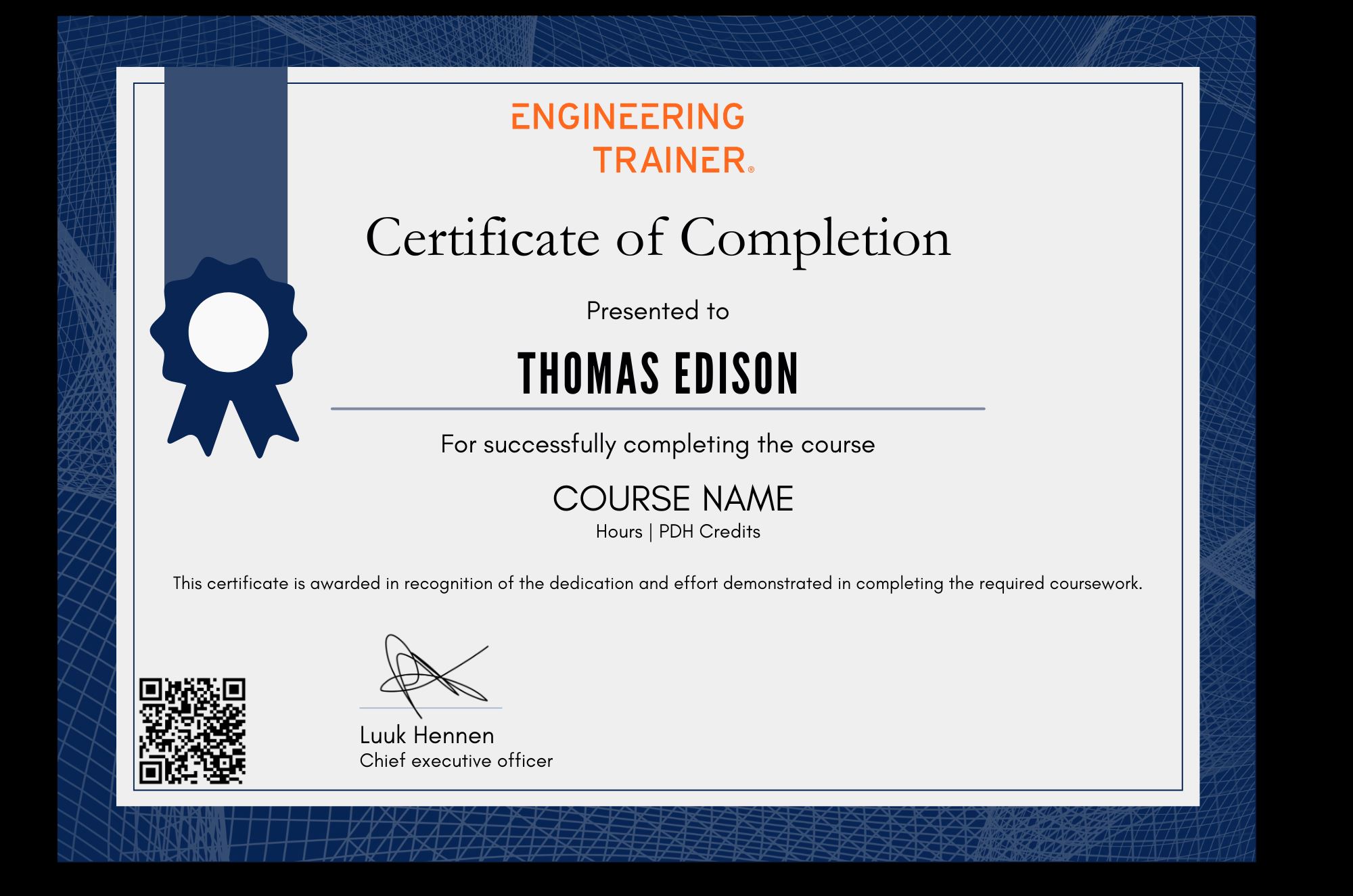
Certification included
-
Industry standard content
Why take this course?
This FEPipe course covers shell-model setup, stress categorization, nozzle and head templates, piping models, custom attachments, axisymmetric models, fatigue, linearization and dynamic assessment. It helps analysts verify models and interpret results for ASME BPVC Section VIII, Division 2 work. This self-paced online course includes video lectures, worked examples and a completion certificate with PDH credits.

What you'll learn
After completing this course, you...
• are familiar with the FEPipe Interface,
• know how to work with the templates in FEPipe,
• have a basic understanding of Stress Categorization as per ASME BPVC VIII-2,
• know how to visually verify model settings & mesh,
• can build custom structures in FEPipe using plates,
• are able to combine models to analyze complete geometries,
• know how to model piping actions and calculate SIFs,
• know how to utilize line and surface loads for your models,
• are able to use the axisymmetric template,
• can perform fatigue analysis using linearization in FEPipe,
• are able to calculate eigenmodes and buckling modes using dynamic assessments,
• understand how to perform thermal transient calculations in FEPipe,
• can use the drawings tools options in FEPipe.
-
 1-year access
-
 By Industry Experts
-
 100% Online Course
About the course
This course teaches you all the fundamentals of working with FEPipe and is beneficial for both new and existing users.
Many different aspects of FEPipe are covered, including the analysis of typical geometries such as heads and nozzles, but also custom attachments, build using plates, and assemblies of multiple models are discussed. The entire workflow is covered in detail including visual model verification, boundary conditions and result viewing options. Also advanced modelling features in FEPipe, flange analysis, thermal transient analysis, calculating mechanical eigenmodes and much more. Also, software courses like AxiPRO and Stressplot, which are part of the PRG Suite and relate to the use of FEPipe, are discussed.
There will also be extensive seminars on Part 5 of the ASME BPVC VIII-2 so that participants become proficient in conducting a “Design by Analysis” assessment.
The course consists of 7 online courses based on video lectures, software tutorials and exercises.
-
Self-Paced Course

-
12hr
-
12 PDH Credits

-
English

-
SPC126

Meet your instructor
Dynaflow Research Group
Dynaflow Research Group is an engineering consultancy working across piping design and analysis, flow dynamics, vibration, FRP piping, pressure equipment and specialist engineering software. Its experience includes EN and ASME design rules for piping and pressure vessels, buried piping, water hammer, pulsation, dynamic stress assessment, vibration measurement, FEA tools, BOSfluids, BOSpulse, PV Elite and NozzlePRO workflows.

Who should attend this course
• FEA analysts starting to use FEPipe• Pressure-vessel engineers modeling heads, nozzles or attachments
• Mechanical engineers conducting ASME Section VIII, Division 2 assessments
• Static-equipment engineers reviewing FEPipe models
• Existing FEPipe analysts who need broader feature coverage
• Technical reviewers assessing FEPipe results
Program & Details
-
Module 1 - Introduction & Stress Categorization

1. Introduction to Finite Element Analysis
2. Introduction to FEPipe
3. Template Roadmap - Which template should I use?
4. Exercise: Stress categorization -
Module 2 - The Nozzle-Shell Template
1. The Nozzle, Plate & Shell Template
2. Plotting and Model Verification Tools
3. Exercise: A basic FEPipe model
4. Exercise: Modelling a vessel with various nozzles
5. Exercise: Vessel-Nozzle Geometry with nozzle end loads -
Module 3 - Piping in FEPipe
1. Piping considerations
2. Modeling in the String Template
3. Exercise: Modelling piping actions
4. Exercise: B31.3 SIF comparison
5. Exercise: Modeling Piping Actions -
Module 4 - FEPipe Features
1. Database Operations
2. Exercise: Database Operations
3. Structural Attachments
4. Exercise: Structural Attachments
5. How to apply line and surface loads in FEPipe -
Module 5 - Axisymmetric Models, Fatigue & Linearization
1. The Axisymmetric Template
2. Flange assessment using AxiPRO
3. Modeling Tube Bundles with AxiSymmetric Template
4. Introduction to Fatigue Analysis
5. Stress Linearization with StressPlot
6. Exercise: Axisymmetric Template & Stress Linearization
7. Exercise: Fatigue assessment
8. Exercise: Thermal Transient
9. Exercise: Stress Linearization -
Module 6 - Dynamic Assessment
1. Introduction to Dynamic, Modal & Buckling Analysis
2. Exercise: Buckling due to external pressure
3. Exercise: Elastic Column Buckling, Natural Frequencies and Harmonic Excitation -
Module 7 - Miscellaneous Topics
1. 3D drawing tools
2. Plastic/non linear assessment
Certification
Related courses




Why choose EngineeringTrainer
-
Unlimited Team-wide Access
-
Advance Technical Competences
-
Courses by Industry Authorities
Since using EngineeringTrainer our internal mentorship has a much more matured character.
Logan Chapman - COO at Chapman Consulting Inc.
Request a Quote
Train Smarter. Grow Faster.
Build real-world skills that help you make better engineering decisions, reduce errors, and stand out in your field.