




Introduction to Steam Turbines
-
 1hr 30min
-
 Self paced
-
Trusted by professionals
-
Certification included
-
Industry standard content
Why take this course?
This introductory steam-turbine course explains the thermal dynamics of a steam cycle and how the key gas path components fit into this cycle. It covers work, enthalpy, phase and heat-flow diagrams, flow direction, blade types and common industrial turbine configurations. This self-paced online course includes video lectures, and a completion certificate with PDH credits.

What you'll learn
After completing this course, you...
• understand what a steam turbine is and how it operates
• understand the key thermodynamic principles behind turbine performance
• can explain the conversion of steam energy into mechanical motion
• understand turbine classifications based on flow direction and blade type
• can identify common turbine configurations used in industry
-
 1-year access
-
 By Industry Experts
-
 100% Online Course
About the course
Join us in this course to learn about steam turbines in an industrial setting. You will first be introduced to the thermodynamics of steam turbines, covering concepts such as work done and enthalpy, followed by phase diagrams and heat flow diagrams based on industry-relevant steam turbines.
The course will then explain the different classifications of steam turbines, starting with radial vs. axial and impulse vs. reaction blading, before moving on to velocity compounding. In the third part, the classification will be explored in more detail, covering topics such as condensing turbines, extraction turbines, back-pressure turbines, reheat turbines, and the role of the API 611 and API 612 standards.
-
Self-Paced Course

-
1hr 30min
-
1.5 PDH Credits

-
English

-
SPC01102M1

Meet your instructor
Dimitris Antoniadis
Power Plant Maintenance Manager

Who should attend this course
• Mechanical engineers new to steam-turbine systems• Rotating-equipment engineers who need a turbine introduction
• Operations engineers working with steam turbines
• Maintenance engineers supporting steam turbines
• Power-plant technicians who need turbine-system context
Program & Details
-
Introduction to Steam Turbines

1. Course Introduction
2. What is a Steam Turbine?
3. Thermodynamics
4. According to Flow Directions
5. According to Blade Type
6. Classification
7. Summary
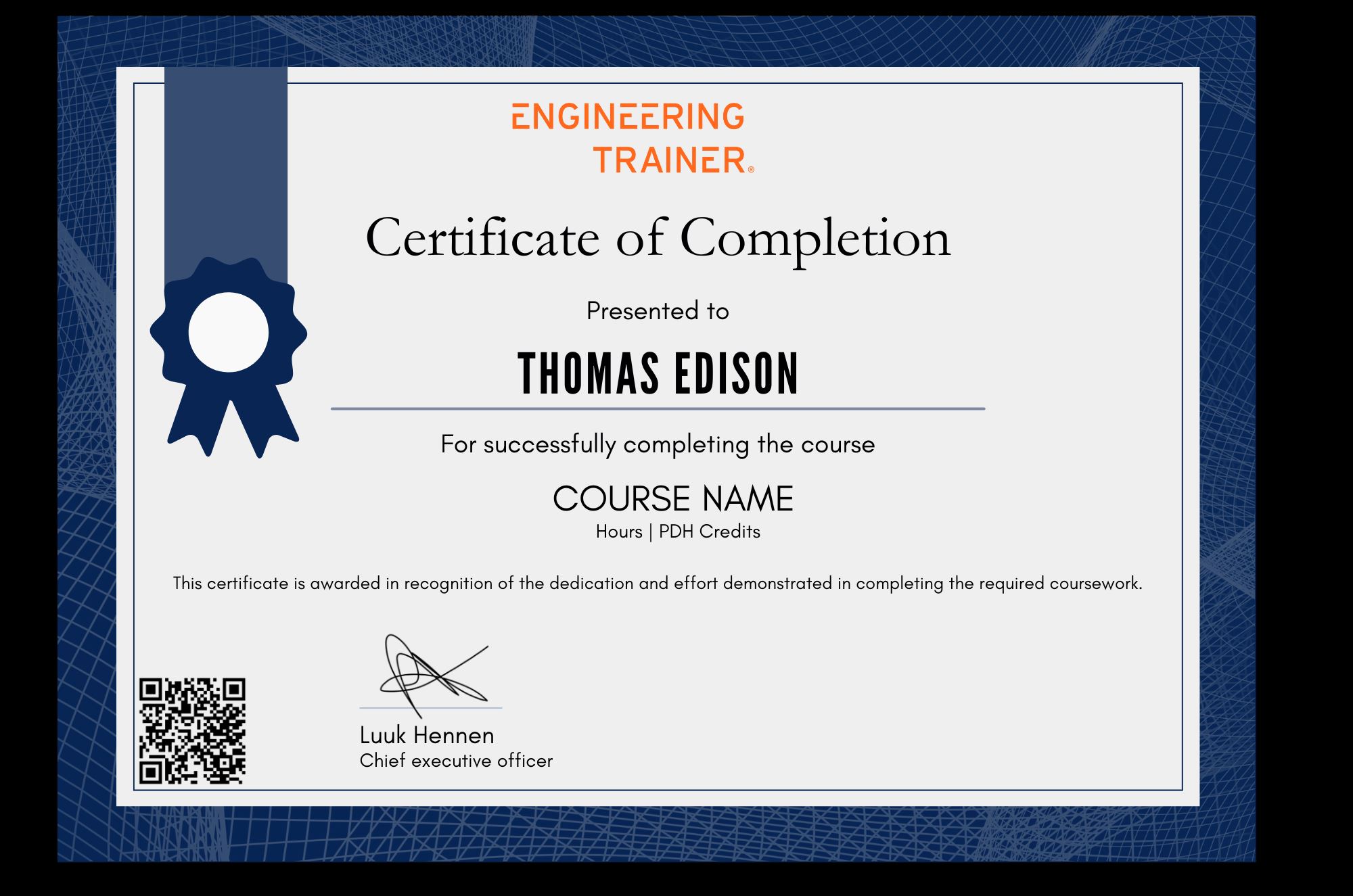
Certification
Related courses


Why choose EngineeringTrainer
-
Unlimited Team-wide Access
-
Advance Technical Competences
-
Courses by Industry Authorities
Since using EngineeringTrainer our internal mentorship has a much more matured character.
Logan Chapman - COO at Chapman Consulting Inc.
Request a Quote
Train Smarter. Grow Faster.
Build real-world skills that help you make better engineering decisions, reduce errors, and stand out in your field.