




Refinery Corrosion Control - Distillation
-
 4hr 40min
-
 Self paced
-
Trusted by professionals
-
Certification included
-
Industry standard content
Why take this course?
This refinery-corrosion course connects crude and vacuum distillation process conditions with equipment damage. It covers the CDU and VDU process flow, corrosion loops, stress-corrosion cracking, naphthenic-acid corrosion, sulfidation and practical mitigation decisions. This self-paced online course includes video lectures and a completion certificate with PDH credits.

What you'll learn
After completing this course, you...
• Have an understanding of the distillation process and its critical components, including CDU and VDU, and their operational flows,
• Can identify and mitigate corrosion risks in the distillation unit of a refinery, leveraging knowledge of corrosion loops and common failure mechanisms,
• Understand key corrosion mechanisms, such as stress corrosion cracking and naphthenic acid corrosion, and are able to recognize their effects and apply mitigation strategies.
-
 1-year access
-
 By Industry Experts
-
 100% Online Course
About the course
Distillation is a critical process in oil refining, separating crude oil into valuable fractions through atmospheric and vacuum distillation. This process involves complex chemical and mechanical systems that must operate efficiently to ensure optimal performance and safety. However, challenges such as corrosion and material degradation can significantly impact system reliability, requiring in-depth knowledge of process operations and failure mechanisms.
In this training course, you will explore the fundamentals of crude oil distillation, gain insight into process flows, and understand the role of corrosion loops in system integrity. You'll also delve into common corrosion mechanisms, including stress corrosion cracking and naphthenic acid corrosion, and learn to recognize and mitigate their effects on refining equipment.
This course consists of 3 online modules based on video content.
-
Self-Paced Course

-
4hr 40min
-
4.5 PDH Credits

-
English

-
SPC3010

Meet your instructor
Christian Lewis
Christian Lewis is an Integrity Services Manager and trainer whose work focuses on corrosion, materials and integrity management. His experience covers corrosion mechanisms, refinery corrosion loops, crude and vacuum distillation, damage recognition and mitigation.


Who should attend this course
• Process engineers working with crude or vacuum distillation units• Mechanical engineers responsible for distillation equipment
• Inspection engineers assessing damage in refinery distillation systems
• Maintenance engineers supporting crude or vacuum distillation units
• Corrosion engineers responsible for distillation corrosion loops
• Integrity engineers responsible for refinery equipment integrity
• Operations personnel who connect process conditions with corrosion risks
Program & Details
-
Distillation Unit Overview

1. Crude distillation unit (CDU): purpose and main sections
2. CDU process flow: crude preheat, atmospheric distillation and product streams
3. Vacuum distillation unit (VDU): purpose and relationship to the CDU -
Corrosion Loops
Introduction to Corrosion Loops
Loop 1: Storage to Desalter Inlet
Loop 2: Desalter Bottoms & Brine
Loop 3: Caustic Injection
Loop 4: Desalted Crude <230°C
Loop 5: Desalted Crude >230°C
Loop 6: Preflash Vessel to Crude Column
Loop 7: Crude Furnace
Loop 8: Crude Furnace Transfer Line
Loop 9: Mid-section of Column
Loop 10: Crude Column Overheads
Loop 11: Cooled Side Streams <230°C
Loop 12: Vacuum Column Furnace
Loop 13: Transfer Line & Side Streams
Loop 14: Dry Upper Vacuum Column
Loop 15: Eductors & Wet Vacuum Overheads
Loop 16: Cooled Column Streams
Loop 17: Debutaniser Top & Depropaniser
Loop 18: Debutaniser Bottom & Depentaniser
Loop 19: Sour Water Systems
Loop 20: Wash Water Supply -
Corrosion Mechanisms
1. Chloride SCC
2. Caustic SCC
3. Polythionic SCC
4. Sour Water Corrosion Chemistry
5. Images of Corrosion Damage
6. Corrosion Under Insulation
7. Naphthenic Acid Corrosion
8. Sulphidic Corrosion
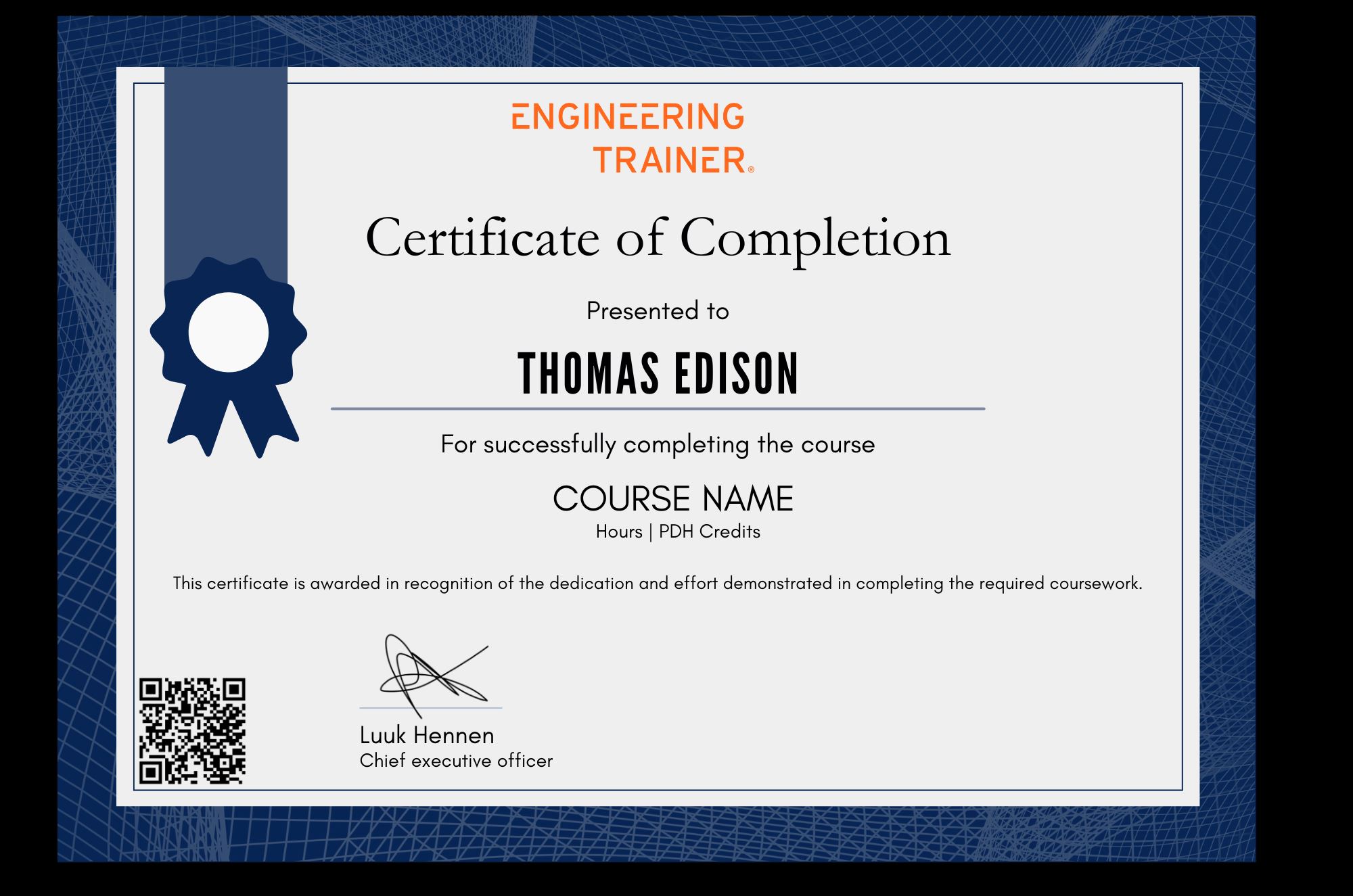
Certification
Related courses


Why choose EngineeringTrainer
-
Unlimited Team-wide Access
-
Advance Technical Competences
-
Courses by Industry Authorities
Since using EngineeringTrainer our internal mentorship has a much more matured character.
Logan Chapman - COO at Chapman Consulting Inc.
Request a Quote
Train Smarter. Grow Faster.
Build real-world skills that help you make better engineering decisions, reduce errors, and stand out in your field.