




Introduction to Pipe Stress Engineering: Fundamentals 2
-
 7hr 30min
-
 Self paced
-
Trusted by professionals
-
Certification included
-
Industry standard content
Why take this course?
This second pipe-stress fundamentals course covers flexibility under ASME B31.3, load combinations, components, supports, flange leakage, special cases and technical reporting. It extends the first course's foundation into the calculations and decisions used in a basic pipe-stress workflow. This self-paced online course includes video lectures, knowledge-check quizzes and a completion certificate with PDH credits.

What you'll learn
After completing this course, you...
• Know all concepts involved in a pipe stress flexibility analysis,
• Better understand code related load combinations,
• Have a good overview of all types of piping components and support types,
• Know about different flange types and calculations,
• Understand special load cases for piping systems,
• Have a detailed understanding of the documentation aspects involved with pipe stress and interfaces with other disciplines.
-
 1-year access
-
 By Industry Experts
-
 100% Online Course
About the course
This course by Stressman Engineering gives you a strong base and understanding of Pipe Stress Engineering. It will enhance your discussions with colleagues, vendors, and clients and refuels you with inspiration and knowledge. In a set of online courses, you learn to understand the design philosophy of pipe stress. With practical examples, the instructors will provide you with a prominent course and give you a complete overview.
The course provides a broad context of the concepts, insights into possibilities for optimization and cost reduction, and a strong base for deeper discussions with colleagues, vendors, and clients.
This Fundamentals course contains 6 online courses based on video content.
-
Self-Paced Course

-
7hr 30min
-
7.5 PDH Credit

-
English

-
SPC502

Meet your instructor
Stressman Engineering
Stressman Engineering specializes in stress analysis, from hand calculations to three-dimensional finite element analysis. Its pipe-stress courses explain piping loads, code checks, equipment interfaces, support choices and technical reporting through practical engineering examples.

Who should attend this course
• Piping design engineers who need a deeper understanding of flexibility and code checks• Piping design leads responsible for piping-system decisions
• Junior pipe stress engineers who have completed the Fundamentals 1 scope
• Mechanical engineers who need a broader view of pipe stress engineering
• Process engineers who need to understand piping loads and equipment interfaces
• Structural engineers who interface with pipe supports and piping loads
Prerequisites
Recommended: completion of SPC501 or equivalent knowledge of pipe-stress purpose, loads, basic stress concepts, piping codes and equipment interfaces.Program & Details
-
Module 1 - Flexibility Calculation as per B31.3

1. Module Introduction & Overview
2. Basic Allowable Stress Tables
3. Allowable Stress due to Sustained Loads
4. Allowable Stress due to Displacement Strains
5. Occasional Stress Allowable
6. Pipe Weight Considerations
7. Fluid Weight Considerations
8. Additional Weight: Insulation & Internal Lining
9. The buoyancy of Piping Systems
10. Elasticity Modules Tables
11. Flexibility Factors & Stress Intensification Factors (SIF)
12. Pressure Stiffening of Components
13. Pressure & Weight Sustained Stresses
14. Pipe Span Calculations
15. Thermal Expansion Coefficient Tables
16. Displacement Stress
17. Expansion Loops
18. Sagging & Hogging
19. Drag loads
20. Wind Loading on Piping Systems
21. Acceleration on Piping Systems
22. Transportation Analysis of Piping Systems -
Module 2 - Load Combination Cases for Pipe Stress Analysis
1. Exercise Review
2. Load Combination Cases Part A
3. Basic Load Combinations Part B
4. Load Combinations Example Part C
5. Load Case Combinations Part D
6. Load Case Combinations Part E
7. Load Case Combinations Part G
8. Scalar Combinations of Loads
9. Non-linearities
10. Load Combinations Example for Pipe Stress Analysis
11. Accidental Loads -
Module 3 - Piping Component and Support
1. Trunnions and welded attachments
2. Cryogenic supports
3. High temperature supports
4. Anti-vibration supports
5. Expansion Joints
6. Spring supports
7. Struts
8. Snubbers -
Module 4 - Flange Leakage Calculations
1. Introduction & Recap
2. Flange Leakage Calculations
3. Kellogg's equivalent pressure method
4. Flange calculation: ASME VIII Division 1 & 2
5. Flange calculation: API TR 6AF & API TR 6AF2 -
Module 5 - Piping Stress Special Cases
1. Category M Fluid Piping as per ASME B31. 3
2. High-Pressure Piping
3. Piping supports settlement
4. Equipment settlements
5. Pipeline / Soil settlements
6. Slug flow
7. Water Hammer or Surge
8. Discharge in open systems: Pressure Safety valves
9. Discharge in closed systems: Pressure Safety valves
10. Acoustic induced vibration (AIV)
11. Flow-induced vibrations (FIV)
12. Summary AIV vs. FIV
13. Vortex-Induced Vibrations
14. Pulsations in Piping Systems (Flow-induced pulsations)
15. Thermal Bowing
16. Hydrogen Induced Stress Cracking (HISC)
17. Jacketed Piping
18. Blast Calculations
19. Recap & Exercise Review -
Module 6 - Reporting a Pipe Stress Analysis
1. Introduction & Overview
2. Reporting a Pipe Stress Analysis
3. Report Build-up
4. Stress Isometrics
5. Audit Documentation
6. Piping Stress Checklist
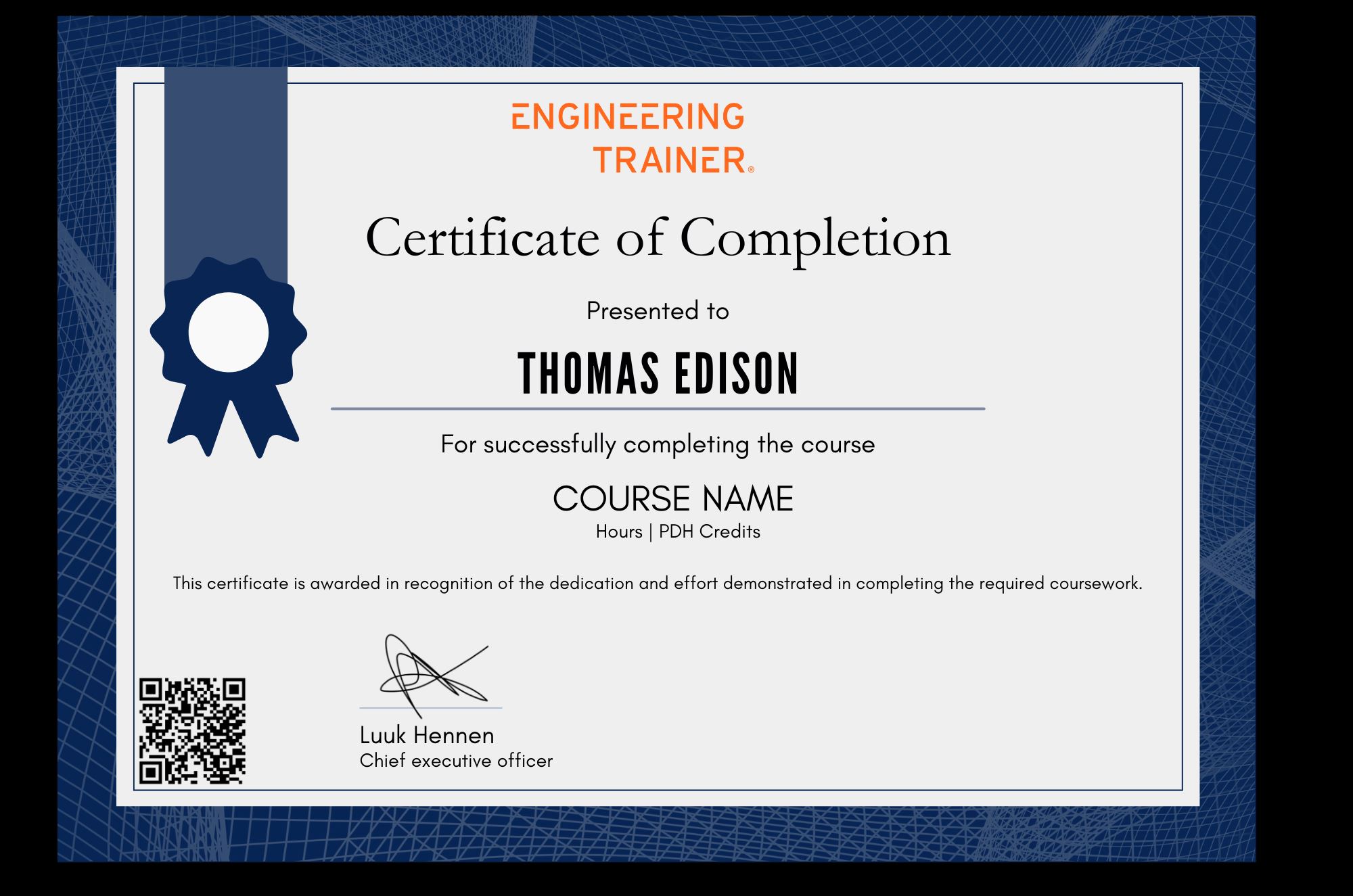
Certification
Related courses


Why choose EngineeringTrainer
-
Unlimited Team-wide Access
-
Advance Technical Competences
-
Courses by Industry Authorities
Since using EngineeringTrainer our internal mentorship has a much more matured character.
Logan Chapman - COO at Chapman Consulting Inc.
Request a Quote
Train Smarter. Grow Faster.
Build real-world skills that help you make better engineering decisions, reduce errors, and stand out in your field.