




-
FEA for Pressure Vessels: When and what level of FEA to use?
-
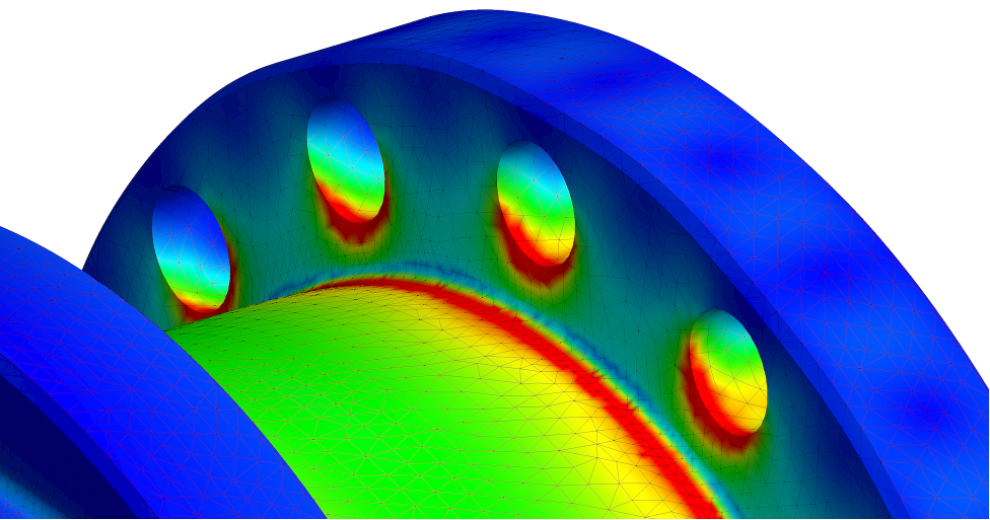
In this blog, let's look at the use of Finite Element Analysis (FEA) in pressure vessel design. A full colour plot, such as the one below, is great for understanding and explaining the stress pattern in your pressure vessel design. However, your engineering time is very limited, and so it is immediately clear that a fully customized brick model for an ASME VIII-2 Part 5 Design by Analysis (DBA) should not be your go-to solution.
Design by Analysis (DBA) using a full FEA package, such as ANSYS or FEMAP, brings with it a significant amount of work in the analysis, reporting, and approval stages, as well as having the experience needed to do it correctly. Thus, it should only be done if necessary, and the project manager is aware of the costs. So, how should you determine if FEA is really needed, and if so, at what level?
-
-
Example of an FEA result plot for the analysis of a flange

-
Level 1: Use Design by Rules
The first step is actually to try and avoid using FEA. You should check that your situation is not covered by Design by Rules, such as those in ASME VIII or EN 13445-3.
Design by Rules are analytical rules that cover most standard geometries and loading patterns, starting with the basic calculation of the wall thickness for a given pressure load through dimensioning flanges (Appendix 2 approach), tubesheets, and nozzle reinforcement. Often, nozzle loading can be included next to the pressure load. These rules give the advantage that you can rapidly change to new geometries and load cases.
An extra advantage of Design by Rules is that you do not require a license for FEA software, and the reporting and review effort is minimal compared to the next more complex steps. A well-documented spreadsheet calculation sheet is sufficient, which is often done for one-off cases or those which are regularly repeated in a company's workflow. Alternatively, Design by Rules software, such as PV Elite, can be used.
-
Continue Learning
See our related courses on the Design by Rules approach in the EN 13445-3 and ASME VIII Div. 1
You can also subscribe to Engineering Insights to receive future technical articles and learning materials.
-
Level 2: Parametric FEA
Design by Rules can often be conservative and do not cover non-standard geometries (for example, a nozzle in a knuckle region) or loading (such as highly cyclic). Additionally, design by rules will not give other outputs that you may require, think of nozzle flexibilities for a piping flexibility analysis.
A nuance here is to check if the design could not be modified to avoid these special cases? Could the nozzle be moved? Is the cyclic loading too conservative? Or could we not use a conservative stiff nozzle boundary condition for the piping study? Once you are sure these are not desired, then you will need to go towards FEA.
Next to design verification, FEA provides a valuable aid in understanding failures by showing where the peak stresses actually arise, and may offer a less conservative approach than design by rules, saving on material costs.
But going to FEA does not necessarily require a full simulation of the whole vessel with a full brick model. A good first step is to see if a parametric approach, such as in the software packages NozzlePRO or FEPipe, is sufficient, as these have standard templates, in-built code assessment checks, and standard output reports.
Remember that linearization of the stress tensors to determine the membrane, bending, and peak stresses is a key part of the post-processing of the results. Using a template-based FEA package can drastically reduce this post-processing step, and the standard output reports will reduce the complexity in the approval process.
-

-
Parametric FEA model of a nozzle in NozzlePRO

-
-
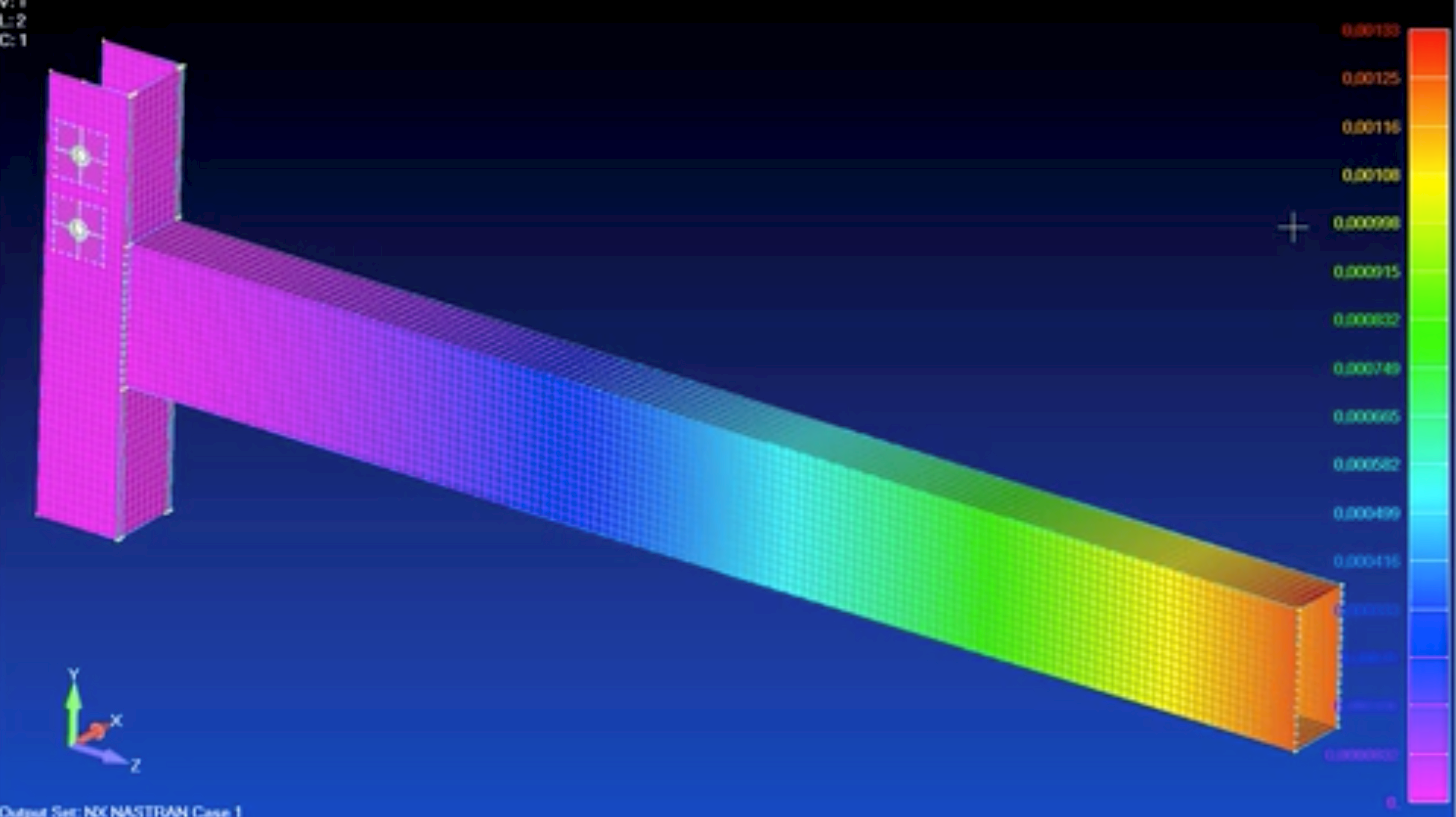
Full FEA (shell) model of a cantilevered beam

-
Advance Your Career
See how experienced engineers apply these calculations, modelling choices, and design codes in real projects.
Explore the related course or subscribe to Engineering Insights.
-
Level 3: Full FEA
If a parametric model is not possible, then a full FEA package such as ANSYS or FEMAP is your next stop. With a full FEA software package anything is possible, including fully non-linear plastic simulations, elastic-plastic buckling, and thermal transients. Although note license add-ons may be needed if going beyond an elastic analysis.
As is a theme throughout this article, and in any project in general, you should keep your analysis as simple as possible; often for pressure vessels a shell model will be sufficient; only if through the wall effects are important should a brick model be used. The model size should also be limited where possible to reduce the simulation time and complexity of what needs to be reviewed. So focus on making only a model of the region of interest with appropriate boundary conditions and mesh resolution, don't model an entire vessel with a fine mesh to analyse one nozzle. Here it is important to be aware of what you need in terms of mesh resolution. Remember that peak stresses are found in ASME VIII-2 Part 5 using an FSRF in combination with the membrane and bending stresses, not by modelling the weld in detail.
The Levels of FEA for a Pressure Vessel analysis
In this article we've tried to give a quick overview of the different levels of FEA analysis for pressure vessel analysis conform EN 13445-3 or ASME VIII Div. 1 or Div. 2. The focus, even if you go to Level 3 here, is on keeping it simple; you need to use your time efficiently and be aware of the reporting effort that is required for an FEA simulation.
So here are the levels:
- Level 1: Design by Rules
- Level 2: Parametric FEA
- Level 3: Full FEA
And of course, Level 3 can be split into further levels for elastic or non-linear, and steady state or transient analyses.
FEA is a valuable tool, and feel free to check out our training courses that may help you with your code-conforming analyses.
Related Courses
If this article was useful, the related courses explore the full engineering framework behind this topic, including calculations, design considerations, and practical examples.
-

Designing according to the EN 13445 code
This course covers the EN 13445 design code for unfired pressure vessels, explaining key principles and equations behind the rules. Participants explore topics like area replacement, the Taylor and Forge method, stress evaluations, and vacuum collapse prevention.

-

NozzlePRO Essentials
This self-paced course covers comprehensive fundamentals and advanced features of NozzlePRO software, including finite element templates, load setup, model verification, and ASME VIII-2 stress categorization.

-

Finite Element Analysis (FEA) Essentials
This self-paced course focuses on mastering Finite Element Analysis (FEA) concepts and design choices, emphasizing engineering judgment in model design, analysis, and result interpretation.

-

Designing according to the ASME BPVC VIII-1 code
This self-paced course offers an in-depth understanding of the ASME VIII-1 design code for pressure vessels. Explore fundamental equations, key principles, and design rules for shells, heads, nozzles, flanges, and more.

-

Working with ASME VIII-2 ch. 5: “Design by Analysis”
This self-paced course series covers ASME VIII-2 Part 5 design by analysis rules for pressure vessels using FEA. You will learn how to conduct compliant FEA studies, including checks for rupture, ratcheting, fatigue, and buckling.

-
Engineering Insights
Stay updated with practical engineering insights drawn from new articles, learning materials, and expert discussions.
We occasionally share concise explanations covering topics such as piping stress analysis, pressure vessel calculations, fatigue assessment, engineering codes (ASME & EN), and practical modelling approaches.
-