




Gas Turbines: Operation, Maintenance and Troubleshooting
-
 16hr
16hr
-
 This IN-COMPANY training is not available as part of the MEMBERSHIPS, but can be booked private.
Why take this course?
Master the fundamentals of gas turbine operation in this instructor-led course covering all major components, control systems, and auxiliary systems. Learn practical inspection, maintenance, and troubleshooting techniques, including real damage cases. Available as in-house training—online or onsite—with full course materials provided. The course includes video lectures, quizzes, and real-world case studies. Earn a certificate with PDH credits upon completion.
What you'll learn
After this course, you...
• have seen how to troubleshoot, maintain and inspect gas turbines in a professional manner,
• know how to use the outputs from instrumentation and inspections to monitor gas turbine performance and troubleshoot failure modes,
• have seen how the thermodynamic cycle works, the reasons for design choices and how operating points can influence the emissions,
• have an overview of industry standard guidelines and procedures for gas turbine operation and maintenance,
• have the knowledge needed to take a leading role around a gas turbine and to teach other professionals to work efficiently with a gas turbine.
-
 Private Course for your Team
-
 Industry Expert Instructor-Led Training
-
 Scheduling based on client requirements
About the course
This instructor lead course takes the students on a tour of all aspects of gas turbine operation, with maintenance, inspection and troubleshooting featuring prominently. All of the components in the gas path, from the air intake, through the compressor, combustor and turbine are covered, as well as the auxiliary systems, with the reasoning behind design choices being explained in a practical manner. Thermodynamics, flame stability, surge and stall and emissions are among the many topics covered.
Within the course the control systems, and inspection and maintenance procedures for a gas turbine are shown. With knowledge of these the student will have the troubleshooting skills to diagnose failure mechanisms, such as misalignment, imbalance, oil whip and erosion, and performance degradation. The instructor will also take the student through cases of real damage and life degradation cases on turbines and explain different repair strategies.
The course is formed of 8 modules split across 2 training days. All courses will be live sessions with the instructor. This training course is available as a company in-house training only; there is a choice between an online training or an onsite training. All training materials will be available through your EngineeringTrainer account.
-
16hr
-
16 PDH Credits

-
English

-
INCO1101

Meet your instructor
Dimitris Antoniadis
Power Plant Maintenance Manager

Who should attend this course
Personnel who are responsible for the operation, maintenance and fault identification on gas turbines, such as:• Engineers
• Supervisors
• Technicians
• Operators
Prerequisites
General technical backgroundProgram & Details
-
Total Cover of your Asset
 Live
Live

1. Industry standards and best practices
2. ISO conditions
3. External factors affecting gas turbine performance
4. Procurement, construction and commissioning -
Main Systems Overview
Live
1. Thermodynamic cycle
2. Inlet duct and filters
3. Axial flow compressors; design and operating conditions
4. Compressor surge, stall and fouling
5. Compressor cleaning
6. Combustors; design and operating conditions
7. Flames and fuel quality
8. Combustor operating point versus emissions
9. Power turbine; design and operation
10. Seals and replacement
11. Bearings and loads
12. Shaft configurations -
Auxiliary Systems
Live
1. Fuel Gas System
2. Lubrication Oil System
3. Oil Inspection
4. Fire Detection
5. Extinguishing Systems -
Gas Turbines Inspections
Live
1. Combustion Inspection
2. Hot gas path Inspection
3. Major Inspection
4. Borescope Inspections
5. Inspection using NDT (Non-destructive testing)
6. Inspection intervals and schedules -
Control Systems Troubleshooting
Live
1. Startup and shut down control
2. Temperature control
3. Acceleration control
4. Speed/Load control
5. Protection systems
6. Acceptance test requirements -
Mechanical Failure
Live
1. Failure due to fatigue
2. Corrosion
3. Abrasion and erosion+E30 -
Troubleshooting through Operational Analysis
Live
1. Monitoring and Diagnostic Systems
2. Vibration monitoring
3. Unbalance
4. Misalignment
5. Rubbing
6. Oil Whip and Oil Whirl
7. Gears; eccentricity, backlash and misalignment
8. Industry standard guidelines -
Maintenance Strategies
Live
1. Major factors influencing maintenance schedule
2. Damage cases and repair strategies
3. lade repair; machining, re-bucketing and testing
4. Rotor balancing
5. Hot parts life evaluation
6. Thermal Barrier Coatings
7. Rotor life
8. Fretting
9. Repair or replace?
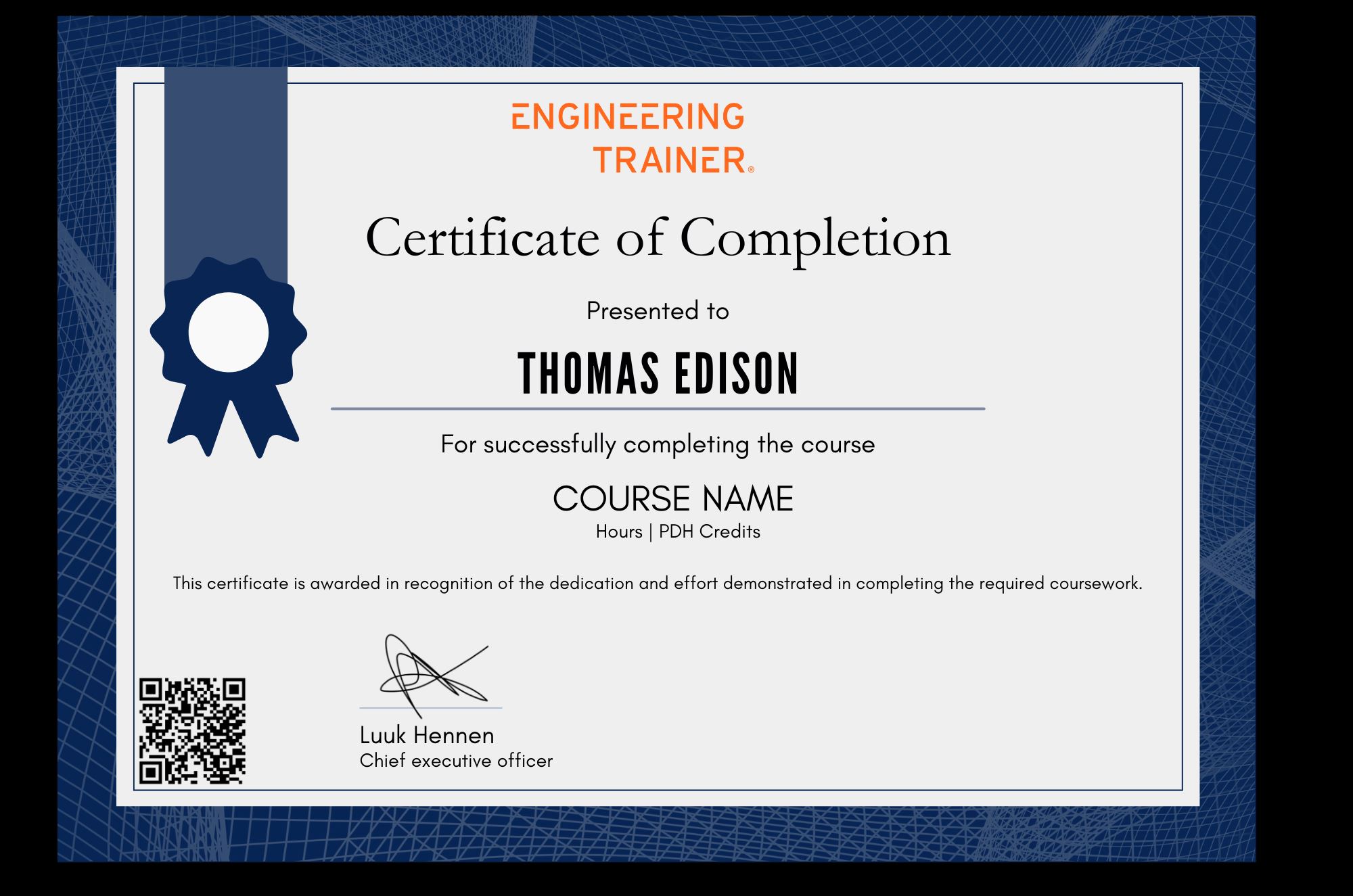
Certification
Related courses

Why choose EngineeringTrainer
-
Unlimited Team-wide Access
-
Advance Technical Competences
-
Courses by Industry Authorities
Since using EngineeringTrainer our internal mentorship has a much more matured character.
Logan Chapman - COO at Chapman Consulting Inc.
Request a Quote
Train Smarter. Grow Faster.
Build real-world skills that help you make better engineering decisions, reduce errors, and stand out in your field.