




Essentials of Metal Fatigue
-
 3hr 45min
-
 Self paced
-
Trusted by professionals
-
Certification included
-
Industry standard content
Why take this course?
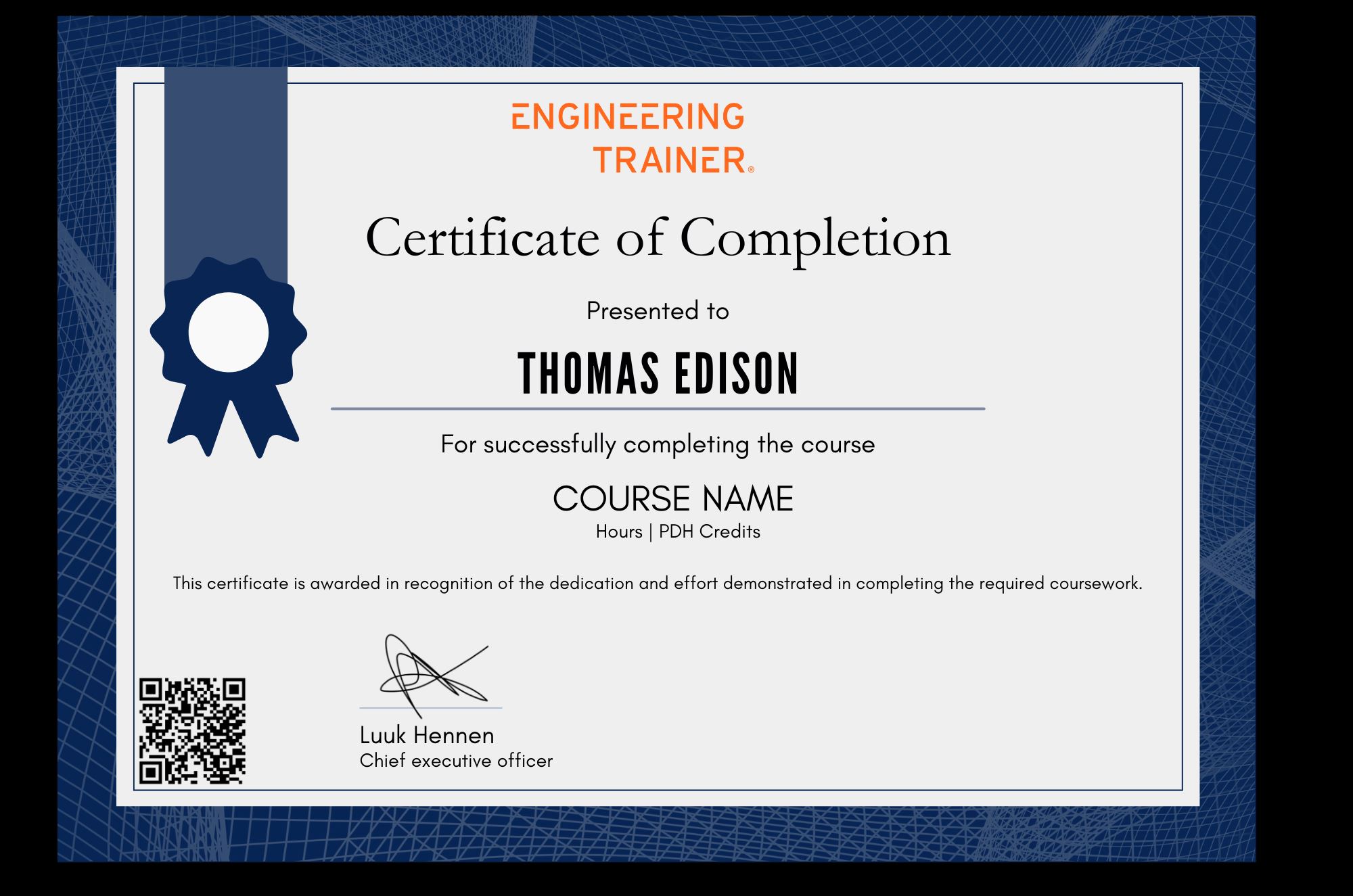
This metal-fatigue essentials course introduces fatigue mechanisms, material behavior, notch effects, nominal-stress analysis and fatigue-aware design. It is intended for engineers who need a compact technical basis for design or review work before moving to advanced fatigue methods. This self-paced online course includes video lectures, knowledge-check quizzes and a completion certificate with PDH credits.

What you'll learn
After completing this course, you...
• have seen in depth the steps in the fatigue mechanism, from crack initiation and crack growth, to fatigue failure.
• are familiar with an S-N curve, and the impact of different factors such as loading type, component size and material strength on the fatigue life.
• understand how stress concentrations factors can be calculated and used to determine the effect of notches and other geometric features on the fatigue life.
• can calculate the fatigue life for a component under different loading conditions and the impact of safety factors.
• will have seen the underlying experimental tests and theory which forms the basis of the fatigue design S-N curves and stress concentration factors.
-
 1-year access
-
 By Industry Experts
-
 100% Online Course
About the course
Did you know that the number of structural failures due to fatigue is far larger than due to static overload? Managing and preventing problems due to metal fatigue should be considered as a key capability of a structural engineer. Safe operation of your structural asset is important to you; you want to avoid your structure collapsing.
This course will teach the essentials of metal fatigue. The first courses explain about the fatigue mechanism, explaining the steps in crack growth before showing the effect of factors such as loading type, mean stress and material. In practice fatigue failure occurs at stress concentrations and the next courses explain these and their effect on component fatigue life. The course concludes by explaining design steps to be taken and practical examples of good and bad design practice. Throughout the course the focus is to teach what is the underlying theory to expand engineers knowledge beyond the S-N curves seen in design codes.
The course consists of 3hr 45mins online courses based on video content together with exercises to reinforce your learning. All training content is provided through your EngineeringTrainer account.
Please note, the course "Comprehensive Guide to Fatigue" is also offered in our portfolio. courses 1 to 5 of the "Comprehensive Guide to Fatigue" are the same as the content in this "Essentials of Metal Fatigue" course.
-
Self-Paced Course

-
3hr 45min
-
4 PDH Credits

-
English

-
SPC1003

Meet your instructor
Johannes Homan
Johannes Homan is a fatigue and damage-tolerance specialist with an aerospace-engineering background. After working at Fokker Aircraft, he founded Fatec Engineering in 1996 and also worked as a researcher and assistant professor at Delft University of Technology. His courses cover fatigue mechanisms, life analysis, testing and damage-tolerant design.


Who should attend this course
• Stress engineers who need the essentials of metal fatigue• Structural designers responsible for fatigue-sensitive components
• Test engineers involved in fatigue testing
• Lead engineers reviewing fatigue calculations
• Engineering managers overseeing fatigue-related design work
Program & Details
-
Module 1 - What is Fatigue

1. What is fatigue?
2. Why is fatigue important?
3. Fatigue mechanisms & phenomena -
Module 2 - Fatigue of Materials
1. Effect of materials
2. Effect of mean stresses
3. Type of loading.
4. Effect of Component Size -
Module 3 - Effect of Notches
1. Stress concentrations
2. Fatigue limit for structures
3. S-N curves for structures -
Module 4 - Fatigue Analysis - Nominal Stress
1. Introduction to fatigue life analysis
2. Fatigue predictions using nominal stresses
3. Examples
4. Safety factors -
Module 5 - Fatigue Design Practices
1. Fatigue-aware design process
2. Accuracy and limits of fatigue analysis
3. Practical examples of good and poor fatigue design -
Module 6 - Assignment
1. Course assignment
Certification
Related courses

Why choose EngineeringTrainer
-
Unlimited Team-wide Access
-
Advance Technical Competences
-
Courses by Industry Authorities
Since using EngineeringTrainer our internal mentorship has a much more matured character.
Logan Chapman - COO at Chapman Consulting Inc.
Request a Quote
Train Smarter. Grow Faster.
Build real-world skills that help you make better engineering decisions, reduce errors, and stand out in your field.